onsdag 30. januar 2013

"The Things They Carried", by Tim O`Brien


“The Things They Carried” is perhaps the most mind twisting, heart sinking, and unbelievable mind-blowing book I have ever read. After every chapter I was left stunned and had to sit back and reflect on what I just read.


Tim O`Briens book was the first novel based on a man’s experiences in the war zone, and I don`t think any other book with the same topic will feel the same. There are extremely few movies and books these days that actually make you question humanity, but this one did.

The novel is a collection of short stories about the Vietnam war. The perspective shifts, sometimes we feel like we are listening to him speaking directly to you, telling what he sees at the very moment, or if he is reflecting on something that happened a very long time ago. At times it feels like the stories are true. I believed for a long time that all of them were. Maybe they are, maybe they are not. Whether they are or not is not so important I have discovered. At least we can assume that they are based on reality, and the exoeriences Tim O`Brien and other veterans he met.

The chapters range from only two pages up to more than 20 at times. The stories are everything from pro war to post war and of course in the heat of a combat. It features several characters, including O`Brien himself, while struggling trough the everyday life as a foot solider in Vietnam. We are told about the definition of a true war story, the stories of friendships with tragic endings, and encounters with the Vietnamese people.

 But before reading this book, if you ever consider doing so, be aware that it is written in a way that you sometimes don`t understand what is exactly going on. Things don`t make sense. First one thing is said, and then the author states the other. It is hard to keep track on what you read. It requires you to be aware of the story, and it requires you to THINK. So I suppose this is not a book for everyone.
But overall, it was a great piece of writing. Doing homework on this book was not a bore, even in the midst of my summer break.

-Johanne.


Speaking of courage


I think this must have been my favorite part of the book. Speaking of courage talks about moving forward after the war. The official aftermath. Something that not everyone handles very well

O`Brien speaks here about his fellow soldiers during the war, one who did not cope very well. The author says he managed to get back to normal after the war, it was almost weird how everything went back to normal. The main character of the chapter did not do as well, though, his name is Norman Bowker and the chapter represents his struggle to get comfortable talking about the war.

The chapter is written in a third person point of view and O`Briens opinions are not included in this chapter. He is pretty much absent from the story, but trough a steam-of-conciounes we see Norman`s problems. He feels alone and abandoned after the war. His high school girlfriend is married, and he believes his father is only interested in watching baseball.

The main character of “Speaking of courage” has no one to turn to. He does not believe people will respond the way he wants to his story about how his friend Kiowa died in “the shit field”. He believed that his father, as a WW2 veteran would question his bravery,and that his old girlfriend would be disgusted by the details. Carrying a burden is hard, but not having anyone to share it with is even harder.


Norman Bowker is circling a lake in his father’s van. Every time he finishes, he goes for another loop, while watching the people. It`s described that he feels “safe” inside the car, which might mean that this is somewhere he can think, where he doesn`t have to confront people and try to tell them his war story. While he sits there, he imagines himself telling the story to his family and friends, and he imagines himself failing to finish the story. The endless trip around the lake might represent him looking for a way to tell his family about this, or his search for an answer. He goes around and around, but never realy finds the courage to speak to anyone.

It becomes obvious that Norman never really left the war. He can`t speak about it, and he can`t think of anything else to talk about. His struggle is almost frustrating to read about.


A reason why so many soldiers committed suicide after the war might be the fault of the common population. We are to used to see heroic action in movies. People jumping away from explosions the very last second, people swimming long distances to save friends in need and help the poor. Not people dragging themselves through, literally “a shit hole” one rainy night being fired at from nowhere by the enemy. We think we can “define” courage. In the chapter “how to tell a true war story” O`Brien states that the world of the solider and the outsider/the common people is huge, and that they would not understand.

When I was 15, I had my first boxing match ever. I think it was one of the most intimidating moment of my life. I was pumped on adrenaline, my body forgot what to do, and when I was done I sat down somewhere alone and just waited for my own hands to stop shaking. The woman I had met in the ring was probably more than ten years older than me, taller, and a lot heavier. I was scared telling people about my reaction, as their response would be mixed. I was afraid other fighters would disapprove of me, call me “a damn whimp”. I was afraid my friends would get all over themselves and start comforting me when I in fact didn`t want that. I was afraid that my father might tell me I was not made for this sport, and would tell me to do something different instead.

This is nothing compared to the story, I know, but the tight gut feeling of fearing to be rejected was there. It eats you from the inside, and won`t go away until you get it of your chest and tell someone what you are holding back, it is very simple.

One of the things O`Brien might be trying to tell us is that none of us are fearless. None of us would walk away from the war not bringing something with us, whether it is a scar, a memory that won`t fade or an urge to write about all of those things. The things they had in their backpack were probably not the only things they were carrying back from the war.

-Johanne

Todays image of war.


I once asked a guy what he wanted to do when he finished high school. He told me he wanted to go into the marines. When I asked him exactly why, he answered bluntly “Because I want to do like in the game Call of Duty.”

The image we perceive today about war is completely wrong. Big businesses like the American movie industry, the Gaming industry and grim war novels. None of them perceive war like it was real. When looking at movies and comparing them to Tim O`Briens novel, they seem like fiction. Even though O`Brien states that none of the things in the book are real, they are more real than what we see on television. They are more real than the  so called “pride” and “bravery” we see in the games thousands of boys play. I swear that in war, there is not going to be any epic slow motion running through a fire storm.


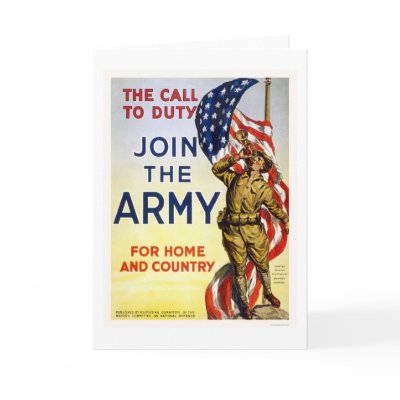
Call of duty sounds a lot like the quote on the propaganda poster to the left, “The call to duty.” The game follows soldiers from different country, but mainly British and American in fights during WW2. It is not displayed as a serious game, but a rather brutal and violent game where the purpose is only to kill the enemy as quick as possible. What is this? What is the purpose of this? We all played war games when we were kids, but should we continue even when we are old enough to understand what it really means?


Sadly, this sells, and the gaming industry earns millions of dollars every year on this industry. I guess you cannot take away people`s right to play video games, but we all sort of lose sight of reality. The bitter truth is still not there. I wonder what happens when one of those boys eventually join the army, and discover that it`s not a game anymore, no rewind buttons, no extra lives.

It`s very, very simple why the movie franchise does this. Very few people enjoy movies that leave them feeling hollow and sad. War movies, about real war stories usually have a rather tragic ending. That is how O`Brien says you can tell the difference of a true story and a real one. The very real ones leave with a deep feeling in the gut, something that just tells you that “this is real, this is no joke”. The author really put me back on track when it comes to war, to at least try to understand it. I just wish the boys who want to go to war knew the same.

-Johanne


I Haven't Forgotten (P.O.W.s)


I squint my eyes in the morning sun 

As it invades my solemn slumber 
I awaken in such a beautiful canyon as this 
With no cares for the day! 
I take a deep breath 
As reassurance that tranquility still lives 
And even in this placid realm 
With the peace of mind I've obtained 
My heart still hurts, 
Hurts for those 
Who never made it back from the war 
And are still alive!

- Pete "the Greek" Agriostathes - 

B/1/501

This is a poem from the page http://www.lzsally.com/popage.html, a page built for poetry made by soliders from the Vietnam war. It is definitly a page to check out,a lot of insightfull writing on that page.