onsdag 30. januar 2013

"The Things They Carried", by Tim O`Brien


“The Things They Carried” is perhaps the most mind twisting, heart sinking, and unbelievable mind-blowing book I have ever read. After every chapter I was left stunned and had to sit back and reflect on what I just read.


Tim O`Briens book was the first novel based on a man’s experiences in the war zone, and I don`t think any other book with the same topic will feel the same. There are extremely few movies and books these days that actually make you question humanity, but this one did.

The novel is a collection of short stories about the Vietnam war. The perspective shifts, sometimes we feel like we are listening to him speaking directly to you, telling what he sees at the very moment, or if he is reflecting on something that happened a very long time ago. At times it feels like the stories are true. I believed for a long time that all of them were. Maybe they are, maybe they are not. Whether they are or not is not so important I have discovered. At least we can assume that they are based on reality, and the exoeriences Tim O`Brien and other veterans he met.

The chapters range from only two pages up to more than 20 at times. The stories are everything from pro war to post war and of course in the heat of a combat. It features several characters, including O`Brien himself, while struggling trough the everyday life as a foot solider in Vietnam. We are told about the definition of a true war story, the stories of friendships with tragic endings, and encounters with the Vietnamese people.

 But before reading this book, if you ever consider doing so, be aware that it is written in a way that you sometimes don`t understand what is exactly going on. Things don`t make sense. First one thing is said, and then the author states the other. It is hard to keep track on what you read. It requires you to be aware of the story, and it requires you to THINK. So I suppose this is not a book for everyone.
But overall, it was a great piece of writing. Doing homework on this book was not a bore, even in the midst of my summer break.

-Johanne.


Speaking of courage


I think this must have been my favorite part of the book. Speaking of courage talks about moving forward after the war. The official aftermath. Something that not everyone handles very well

O`Brien speaks here about his fellow soldiers during the war, one who did not cope very well. The author says he managed to get back to normal after the war, it was almost weird how everything went back to normal. The main character of the chapter did not do as well, though, his name is Norman Bowker and the chapter represents his struggle to get comfortable talking about the war.

The chapter is written in a third person point of view and O`Briens opinions are not included in this chapter. He is pretty much absent from the story, but trough a steam-of-conciounes we see Norman`s problems. He feels alone and abandoned after the war. His high school girlfriend is married, and he believes his father is only interested in watching baseball.

The main character of “Speaking of courage” has no one to turn to. He does not believe people will respond the way he wants to his story about how his friend Kiowa died in “the shit field”. He believed that his father, as a WW2 veteran would question his bravery,and that his old girlfriend would be disgusted by the details. Carrying a burden is hard, but not having anyone to share it with is even harder.


Norman Bowker is circling a lake in his father’s van. Every time he finishes, he goes for another loop, while watching the people. It`s described that he feels “safe” inside the car, which might mean that this is somewhere he can think, where he doesn`t have to confront people and try to tell them his war story. While he sits there, he imagines himself telling the story to his family and friends, and he imagines himself failing to finish the story. The endless trip around the lake might represent him looking for a way to tell his family about this, or his search for an answer. He goes around and around, but never realy finds the courage to speak to anyone.

It becomes obvious that Norman never really left the war. He can`t speak about it, and he can`t think of anything else to talk about. His struggle is almost frustrating to read about.


A reason why so many soldiers committed suicide after the war might be the fault of the common population. We are to used to see heroic action in movies. People jumping away from explosions the very last second, people swimming long distances to save friends in need and help the poor. Not people dragging themselves through, literally “a shit hole” one rainy night being fired at from nowhere by the enemy. We think we can “define” courage. In the chapter “how to tell a true war story” O`Brien states that the world of the solider and the outsider/the common people is huge, and that they would not understand.

When I was 15, I had my first boxing match ever. I think it was one of the most intimidating moment of my life. I was pumped on adrenaline, my body forgot what to do, and when I was done I sat down somewhere alone and just waited for my own hands to stop shaking. The woman I had met in the ring was probably more than ten years older than me, taller, and a lot heavier. I was scared telling people about my reaction, as their response would be mixed. I was afraid other fighters would disapprove of me, call me “a damn whimp”. I was afraid my friends would get all over themselves and start comforting me when I in fact didn`t want that. I was afraid that my father might tell me I was not made for this sport, and would tell me to do something different instead.

This is nothing compared to the story, I know, but the tight gut feeling of fearing to be rejected was there. It eats you from the inside, and won`t go away until you get it of your chest and tell someone what you are holding back, it is very simple.

One of the things O`Brien might be trying to tell us is that none of us are fearless. None of us would walk away from the war not bringing something with us, whether it is a scar, a memory that won`t fade or an urge to write about all of those things. The things they had in their backpack were probably not the only things they were carrying back from the war.

-Johanne

Todays image of war.


I once asked a guy what he wanted to do when he finished high school. He told me he wanted to go into the marines. When I asked him exactly why, he answered bluntly “Because I want to do like in the game Call of Duty.”

The image we perceive today about war is completely wrong. Big businesses like the American movie industry, the Gaming industry and grim war novels. None of them perceive war like it was real. When looking at movies and comparing them to Tim O`Briens novel, they seem like fiction. Even though O`Brien states that none of the things in the book are real, they are more real than what we see on television. They are more real than the  so called “pride” and “bravery” we see in the games thousands of boys play. I swear that in war, there is not going to be any epic slow motion running through a fire storm.


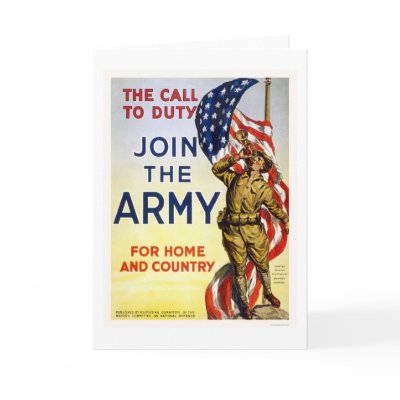
Call of duty sounds a lot like the quote on the propaganda poster to the left, “The call to duty.” The game follows soldiers from different country, but mainly British and American in fights during WW2. It is not displayed as a serious game, but a rather brutal and violent game where the purpose is only to kill the enemy as quick as possible. What is this? What is the purpose of this? We all played war games when we were kids, but should we continue even when we are old enough to understand what it really means?


Sadly, this sells, and the gaming industry earns millions of dollars every year on this industry. I guess you cannot take away people`s right to play video games, but we all sort of lose sight of reality. The bitter truth is still not there. I wonder what happens when one of those boys eventually join the army, and discover that it`s not a game anymore, no rewind buttons, no extra lives.

It`s very, very simple why the movie franchise does this. Very few people enjoy movies that leave them feeling hollow and sad. War movies, about real war stories usually have a rather tragic ending. That is how O`Brien says you can tell the difference of a true story and a real one. The very real ones leave with a deep feeling in the gut, something that just tells you that “this is real, this is no joke”. The author really put me back on track when it comes to war, to at least try to understand it. I just wish the boys who want to go to war knew the same.

-Johanne


I Haven't Forgotten (P.O.W.s)


I squint my eyes in the morning sun 

As it invades my solemn slumber 
I awaken in such a beautiful canyon as this 
With no cares for the day! 
I take a deep breath 
As reassurance that tranquility still lives 
And even in this placid realm 
With the peace of mind I've obtained 
My heart still hurts, 
Hurts for those 
Who never made it back from the war 
And are still alive!

- Pete "the Greek" Agriostathes - 

B/1/501

This is a poem from the page http://www.lzsally.com/popage.html, a page built for poetry made by soliders from the Vietnam war. It is definitly a page to check out,a lot of insightfull writing on that page.

søndag 25. november 2012

What is the American dream we pursue today?


In the play “Death of a salesman” the main character is trying what we call the American dream.
The stereotypical American dream today involves:
-Owning your own house in a nice neighborhood.
-Having 2,5 kids and a station wagon.
-A contemporary lifestyle.

But none of these things are possible without money. Earning a living on less mainstream jobs like art and music is hard. Getting a degree in medicine or any other area that one finds interesting to become one`s own boss requires time and even more money. And when money is what you need to pursue your dream, it is easy to take the easy way out and get a standard job where you can slowly work your way up.
In the modern society it is an essential to make money to be able to live a normal life off the street. For some people in countries with a lower life standard, roof over your head seems to be enough, but this is America, and it is not the case.
Commercial and media keeps telling us what we need, and what we should have, while painting a picture of what is essential to be happy.
What it seems that the American dream is trying to make the citizens of America today, as much as in “The Death of a Salesman”, it is to believe that looking like the perfect reflection of success on the outside, is going to make your life complete. You are as happy as other people think you are. The American dream is not necessarily to be successful and own a big house because you want it, or to get a good position in business because you put your soul into it, it is to make others believe you are happy.
Willy was perhaps the very lecturer of this as he told his son to look his best when he played football. How it delighted him that his son Biff was the champion of his school and everybody looked up to him. The bitter truth here of course is that looking happy far from makes you a fortunate person. Willy might have been the very image of a man who had everything he wanted, until we found out that he had been cheating on his wife. Even if he looked like a man who loved what he was doing, he was just desperately chasing an imaginary dream he created in his head.  It is why he never found himself, and realized that he was not made to be a salesman, he was too busy making money.
If we all just stopped for a moment, stopped thinking about making more, stopped thinking about what other people say about us, and though about what we realy want, would we find ourself? Would making less but feeling more alive make us happier?

onsdag 17. oktober 2012

American media creating stereotypes of socialism.


Ok, so this is only the rough draft of my op-ed, there are going to be a lot of changes I expect, so be nice if you choose to comment on it.

Since the beginning of the cold war, American media has been packed with propaganda against communism and socialism. Movies, newspapers and republicans have been having the tendency to utter the word “socialism” as if it was a dirty word their mom forbids them to say out loud. This is a problem for future politicians if this keeps getting worse than it already is. If a democrat tips slightly over the edge of being liberal, well, I guess he is a communist. And if there is one thing Americans hate, it`s paying their hard earned money as taxes to the state, so they can`t decide what to spend them on themselves.


I was born and raised in Norway, a country that has been awarded as the best country to live in several times, similar to its neighbors: Denmark, Sweden and Finland; who all score very high on the list of best countries to live in. The income per person is high, the average person is very happy with their life, and is expected to live until 81 years. Furthermore, all of these countries are social democracies.

Imagine presenting your beliefs to another person, and a few moments later, they are criticizing you for being a protestant. They keep going on and on forever about how you are wrong, and you have to stand there taking it from them, when you in fact are a catholic. I am not going to compare religion and politics, which are two very separate things. Yet this is not so far from the reality of confusion between social democracy and socialism. Yes, these ideologies share some of the same traits, but they`re not the same. If this is getting too complicated for you to understand, then imagine someone mixing up Twilight and Vampire diaries. Do you follow me now?

Apparently, calling Obama a socialist is supposed to make him a less wanted leader. “Obama wants to take your hard earned money by increasing the taxes”. That being liberal is what`s giving people poor life conditions. I have heard politicians comparing Obamas followers to Soviet spies. With a falling economy, it must be nice having a scapegoat that does not involve themselves.

Their ignorance might not be their fault though. Chances are that they are affected by the stories their fathers told them, older people who learned about communism by being in war with it, and early 60s propaganda. Or, it might be that they just watch a lot of movies.

Communists have since the 1980s been the major bad guy of American movies; the biggest threat, who might look strong on the outside, but is easy to take down. This is where the media seriously starts making a socialist and communists into what they think it should be, and what they want you to think it is.

If you have seen the “Rocky” movies, about the true American boxer, with the fair game attitude who runs through storms and up mountains to get in shape, then you might have noticed how they portray his opponent from the third film. This is the movie where he has to take down the highly intimidating Ivan Drago. A boxer who is an insane 6-foot, 5 inch and 261-pound. Not only does is he given medications, he is trained with advanced machines; he shows no form of sympathy or personality, so of course he is from The Soviet Union.
This is just one of many, many movies. The joker from the dark night rises was dressed to look like a Russian dictator and a French fascist. I mean, if the Europeans always are the bad boys in the movies, I guess it must be true.


None of these sources actually give any insight or background information on any of these ideologies. It just mixes them all up until we get three words with the very same meaning; failure. I have to admit that I learned about the structure of DNA, and the process of a rotting corpse by watching C.S.I, and many of us probably learned moral from Disney movies. Still, not all we see in movies are facts that can be used in real life. If you dance on the street, every person bumping into you is not going to automatically know the dance moves you do, and medieval peasants did probably have as good teeth condition as it might seem.

When I grow old enough to pay my taxes; I will grin my socialist smile and laugh mockingly in the direction of America. Apparently, their whining can`t get me out from under the iron curtain separating our worlds.

søndag 14. oktober 2012

How to write an Op-ed article.

Before writing an Op-ed article, it might be an idea to focus on the outline before getting started. It`s very important to remember that an Op-ed is not like an essay at all. The structure is in fact quite the opposite.
While in an essay you might start of with a topic, and then continuing by discussing and analyzing it. In the last paragraphs, you should have come to a conclusion.

This is not an essay though. An op-ed article is slightly different, and doesn`t allow you to spend so much time pondering and coming up with arguments for every aspect of the topic you are discussing.
Here is a short description of how to write and structure an article, which I will be using for my own op-ed article.


Opening: In the first paragraph of an op-ed article, you state your idea or conclusion. This is not the time to be circuitous or being deep. Be brief and get to the point at once!
An op-ed article is not like an essay. That is why you begin by stating your conclusion, which would usually be the way to end an essay. The explanation is simply because you are going to spend the rest of the article giving proof to support your statement.
Body: Trough out the article, you should stick with three key points, like in an essay. Keep it simple and organized, with short sentences and paragraphs. In addition, an op-ed article should not contain more than 750 words, so there is not exactly unlimited time to come up with arguments.
The people reading this will be the average population, and they require that the language is not filled with jargons, or slow paced and overly philosophic. The man on the street is most likely not familiar with medical terms, or dates of historical events. The language needs to catch their attention. So even if you are writing an article based on information and facts, use a strong voice. Clearly state “I believe that…..” instead of “It could be assumed that……” which makes the article look weak and careful.
Important things to remember:
-Educate your reader. If you know what you write is not common knowledge, apply it.
-Don`t base everything on research. You are allowed to add stories you have heard if they are related to the topic. Readers tend to remember more fun and colorful details. You could also write something we all can relate to.
-If you can relate what you are writing about to something that was recently in the media, then do so!  Timing is important, and these articles draw more attention.
-Avoid clichés or using to much time being philosophic.
-Use humor if the topic allows it. Even though this is an article, you are allowed to be personal and “get dirty”. It can help you make a point.
-Do NOT ramble. Remember the limit of 750 words.
-Express your opinion. And then support it with sources and facts.
Ending: The ending should be the most memorable part of the article. A reader will often skim trough the content of the text and read only the opening and the final paragraph. One very useful technique that is popular among writers is to clearly repeat something they said in the opening. All in all, it should be a summary of the statements and points you made trough out the whole article, and you should re-state your position.